How to Price Your Home Strategically for the Market

An evidence-first Ontario seller pricing guide
How to Price Your Home Strategically for the Market
Short answer: Price a home strategically by first verifying the property facts, then selecting recent and genuinely comparable sales, reviewing the listings competing for the same buyers, and matching the launch plan to your timing, risk and net-proceeds goals. Set review checkpoints before the listing goes live. A strategy is a documented decision process, not a promise that one number will produce a particular sale price or timeline.
List price, market value, offer price and net proceeds are related but different. A high list price does not create value, and a low list price does not guarantee multiple offers. Each approach needs evidence, a marketing plan and a response rule.
Malika Homes lists selling-home support on its owned website. The exact recommendation for a property requires current local data, an inspection of the home and a seller-specific discussion.

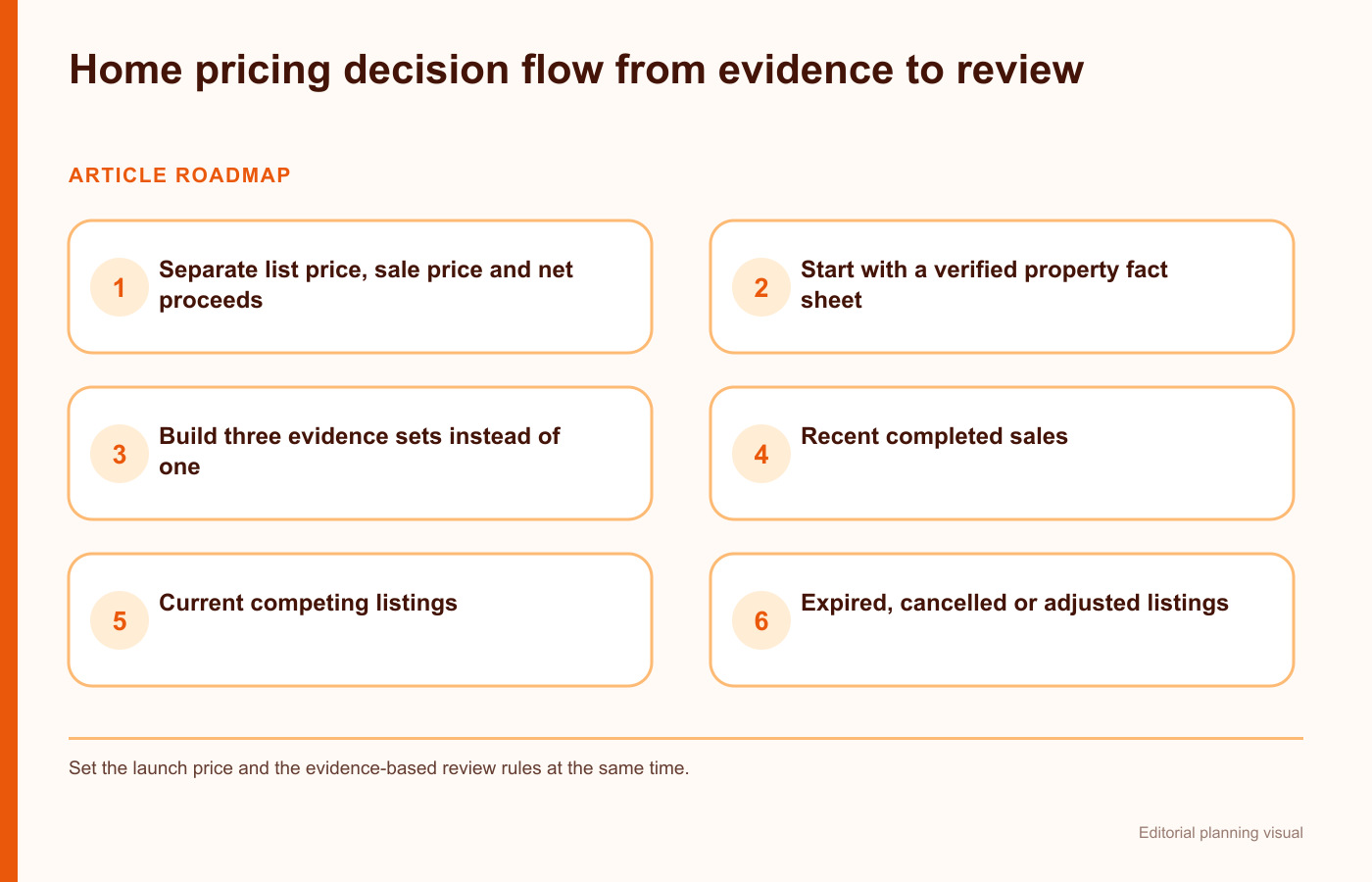
Separate list price, sale price and net proceeds
| Number | What it means | What it does not mean |
|---|---|---|
| Estimated market range | A professional interpretation of current evidence for the specific property | A guaranteed appraisal or sale result |
| List price | The public asking price selected for the launch strategy | The amount a buyer must offer |
| Offer price | A buyer's proposed price within a full set of terms and conditions | Money the seller has received |
| Sale price | The agreed price if a transaction is completed according to its terms | The seller's final cash after costs |
| Net proceeds | Sale proceeds after applicable mortgage, transaction, tax, legal, moving and other seller obligations | A figure that should be guessed from the headline price |
Build the strategy from the seller's actual decision. Is the priority reducing carrying time, preserving flexibility for a purchase, testing a price boundary, or coordinating a specific move? Those goals can conflict. Write them in priority order before debating one list number.
Start with a verified property fact sheet
Pricing comparisons fail when the subject home is described loosely. Record property type, legal and municipal details, lot, above-grade and finished space, beds and baths, parking, basement, age, condition, renovations, inclusions, exclusions, occupancy, condo fees where applicable and any material property information that needs professional review.
RECO's seller checklist recommends accurate listing details supported by documents such as invoices or receipts. Gather permits, warranties, surveys, tax information, utility records, renovation invoices and condominium documents as relevant, then let the appropriate professional decide how each item may be represented or disclosed.
Do not assign a dollar adjustment to every renovation. Buyers may value function, condition and confidence differently, and some work primarily prevents a discount rather than creating a premium. Use documented facts and market reactions, not the seller's cost alone.
Build three evidence sets instead of one
Recent completed sales
Completed transactions show what buyers and sellers agreed in a prior market moment. Select for location, property type, size, condition, age, features, lot and sale date. Explain every major difference. Exclude an impressive sale when its location or condition makes it a poor comparison.
Current competing listings
Active listings show the alternatives a buyer can see now. They are not completed-sale evidence, but they shape attention. Compare photography, condition, features, price band, days available and whether the listing has changed strategy.
Expired, cancelled or adjusted listings
Unsuccessful or revised listings can reveal where the market resisted a price or presentation, subject to complete context. Do not treat every expired listing as proof of overpricing; timing, access, marketing, condition and seller decisions may also matter.
Ask the agent to show the selection criteria, not just the final range. A useful packet includes a map, photos, property facts, relevant dates and notes explaining why each comparison belongs.
Compare pricing lanes and their trade-offs
| Pricing lane | Potential purpose | Main risk | Evidence and control needed |
|---|---|---|---|
| Market-aligned launch | Meet the clearest current evidence | The range may change as new listings or sales appear | Strong comparable set and scheduled refresh |
| Test above the evidence range | Preserve room for a seller who accepts longer exposure | Reduced attention, price reductions or a stale-listing perception | Explicit time limit and adjustment rule |
| Event-style lower list | Concentrate showings or an offer date where appropriate | Buyer response may not reach the seller's acceptable terms | Clear offer process, expectations and contingency plan |
| Value-range positioning | Place the home among competing buyer searches | Portal brackets and buyer comparisons can shift | Search-band analysis and current competition |
No lane guarantees the number or quality of offers. The seller needs to understand what happens if the response is stronger, weaker or simply different from expected. RECO explains that a registered agent can advise on market conditions and seller strategy, while the seller makes the decisions. Review its current working-with-an-agent guidance.
Model costs before choosing the acceptable result
A seller's decision should consider net proceeds and timing, not only the sale price. Build a worksheet with current quotes or professional estimates for every applicable item.
- Outstanding mortgage, discharge terms or other secured amounts.
- Real-estate service fees and applicable tax under the written agreement.
- Legal work and disbursements.
- Repairs, preparation, staging, cleaning, storage or photography not otherwise included.
- Moving, temporary accommodation and closing-date coordination.
- Property tax, utilities, insurance, condominium amounts or other adjustments.
- Tax or benefit implications requiring qualified advice.
- Carrying costs for each additional review period.
RECO explains that representation agreements should identify the services, rights, responsibilities, payment terms and duration. Read the current representation-agreement guidance, compare written proposals and seek independent legal advice where appropriate. Do not invent commission or service amounts; they vary by agreement.
Set objective review checkpoints before launch
Choose a date or exposure milestone for reviewing the strategy. Track qualified showing activity, online engagement in context, direct feedback, repeat visits, offer activity, new competing listings, completed sales and material market changes. Raw views alone do not establish value.
| Observed pattern | Question to investigate | Possible response to discuss |
|---|---|---|
| Low impressions and few showings | Is the listing discoverable in the intended search band? | Review price, category, launch assets and distribution |
| Views but limited showings | Does the presentation or price comparison create hesitation? | Review listing clarity, condition and competing choices |
| Showings but no second visits | What pattern appears in feedback? | Address resolvable issues or revisit positioning |
| Interest but weak terms | Are price, conditions, closing or inclusions the obstacle? | Assess the whole offer strategy with professional advice |
| New competing sale | Does it materially improve the evidence set? | Refresh the comparison rather than reacting automatically |
A price change should have a reason and a new positioning objective. Repeated small reductions without a plan can confuse the market and the seller.
Common strategic pricing mistakes to avoid
- Pricing from the amount you need. Net goals matter, but buyers compare the property with alternatives.
- Using one record sale as the anchor. Check whether it is genuinely comparable.
- Counting renovation dollars one for one. Cost and market reaction are not the same.
- Ignoring active competition. Buyers make choices in the current inventory.
- Assuming a low list guarantees a bidding war. Response remains uncertain.
- Launching without review rules. Decide in advance what evidence triggers a discussion.
- Confusing list price with net proceeds. Model transaction and timing costs separately.
- Making undocumented listing claims. Verify property facts and obtain the right advice.
Frequently asked questions
Should I price my home higher to leave room to negotiate?
That is one possible lane, not a universal rule. Compare the likely buyer search band, current competition, carrying tolerance and review plan before deciding.
Does listing below market guarantee multiple offers?
No. Buyer response depends on the home, market, presentation, exposure, timing and offer process. A seller needs a plan for every response level.
How many comparable sales should I use?
Use enough genuinely comparable evidence to explain a range and differences. Quality, relevance and recency matter more than filling a preset count.
When should I change the list price?
Review at the agreed checkpoint using showing patterns, feedback, new competition and completed sales. A change should have a documented positioning purpose.
Ask Malika Homes for a property-specific pricing packet
Review Malika Homes' seller service and current market articles. Then use the owned consultation route to request a current property fact sheet, comparable selection rationale, competing-listing review, strategy options, seller-cost worksheet, marketing scope and review checkpoints. Verify registration, services, fees and agreement terms before committing.
General Ontario real-estate information only, not an appraisal, legal, tax or financial opinion. Property values, costs, market conditions and transaction terms vary. Obtain current property-specific advice from appropriately qualified professionals.
Tags
Have questions about Ontario real estate?
Book an appointment with Malika Mehrotra to discuss your buying or selling goals.
Book Appointment